 Business Pickup
If you’ve been to your local Cineplex lately, chances are you’ve seen Mark Sultzman’s Tech Talk pre-feature spot reviewing today’s newest electronic gadgets. Mark brought it full circle recently and visited Quantum as part of a campaign to encourage electronics recycling sponsored by EPRA (Electronics Product Stewardship Canada) and OES (Ontario Electronic Stewardship). We’re pleased to have been a part of this campaign. Check out how it came together in the “Cineplex Pre-Movie Programming with Marc Saltzman: Behind the Scenes”.
Quantum Featured in EPRA/OES Ad Campaign
Quantum is pleased to sponsor Partners in Project Green for their annual Waste Collection Drive to encourage recycling of electronics. Clothing donations will also be accepted with proceeds going towards the Canadian Diabetes Foundation. Visit www.partnersinprojectgreen.com/wrw to sign up your organization for this worthy cause!
As the problems posed by waste electronics has grown, governments around the world have enacted various rules and regulations around how they are handled. These regulations often take the form of a stewardship scheme where the manufacturers are responsible for setting up and paying for the collection, transportation and recycling of e-waste.
In Canada, stewardship programs are implemented at the provincial level and overseen by the respective Ministry of the Environment. This paper provides an overview of what type of material is governed by e-waste legislation, the relevant stakeholders and what is happening in each province with regards to electronics recycling stewardship.
Types of Products Covered
The products covered under the various provincial stewardship programs have expanded over the years in phases. All programs started with phase 1, which included standard office and home electronics like computers, printers, monitors and TVs. Phase 2 included home audio and telecommunications equipment such as stereos and phones.
Provinces have expanded their programs at different rates. In BC, phase 5 was implemented in 2015 and now almost every item with a battery or plug is covered under a provincial recycling program. All other provinces have expanded to phase 2 with most considering phase 3 and 4 expansion in the next few years. Only Alberta has never expanded past phase 1, although adjustments are expected soon.
Electronics Products Stewardship Canada (EPSC)
Founded in 2003 to develop and promote sustainable recycling solutions for Canada’s end-of-life electronics, EPSC is an industry-led nonprofit organization whose membership is comprised of the 30 leading electronics manufacturers.
The mandate of EPSC is to represent the interests of manufacturers in shaping the policy environment as well as the development of electronics recycling solutions. To date EPSC, through EPRA (see below), has worked to establish electronic recycling stewardship programs in British Columbia, Manitoba, Newfoundland and Labrador, Nova Scotia, Ontario, PEI, Quebec, and Saskatchewan.
Electronics Products Recycling Association (EPRA)
EPRA is a not-for-profit industry-led organization that oversees and manages the recycling of end-of-life electronics in eight of Canada’s ten provinces, comprising of over 90% of Canada’s population. It is focused on servicing the end-of-life electronics generated primarily by the consumer sector.
In order to ensure items that enter any of the EPRA programs are handled in a responsible and sustainable manner, EPRA will only work with recyclers that have been approved through their Recycler Qualification Office (RQO) to the Electronics Recycling Standard (ERS). The ERS is specific to EPRA and comprises elements of the more widely recognized R2 standard plus some additional components unique to the Canadian marketplace.
Program funding is generated through the collection of Environmental Handling Fees (EHF) at the point of sale of obligated electronic products. These fees are managed at the provincial program level, and distributed to service providers to subsidize the cost of collecting, transporting and recycling.
EPRA-run Provincial Programs
British Columbia
British Columbia has the widest range of obligated products of any Canadian province. Launched in August of 2007, the EPRA BC Program plan has expanded through many phases and currently has more than 1,700 registered program stewards, comprised of manufacturers and retailers.
The program is managed by Encorp Pacific, the provincial bottle depot network, and operated under the brand Return-It™ Electronics. Electronics collected by Encorp are sent to EPRA select approved recyclers for primary processing. Approved processors may also collect material from select businesses and organizations and claim the weight to EPRA. The provincial program generated 4.6 kg per capita in 2015.
Manitoba
One of the newer provincial stewardship programs, EPRA Manitoba was established in 2012. The EPRA MB Program Plan is operated in accordance with the province’s Electrical and Electronic Equipment Stewardship Regulation program. To date, more than 500 manufacturers, retailers, and other stakeholders have registered as program stewards.
The provincial collection network is made up of public and private depots ranging from municipal landfill sites to private retailers. Material is consolidated by the program operators and sent to select EPRA-approved recyclers for primary processing. There are no opportunities for approved processors to collect material outside of the allocation stream or return to retail streams. The provincial program generated 2.7 kg per capita in 2015.
Newfoundland and Labrador
Operating in accordance with the Province’s Waste Management Regulation, the EPRA Newfoundland and Labrador Program is currently comprised of more than 270 program stewards that includes manufacturers, retailers, and other stakeholders. The program has been operating since 2013.
Like Manitoba, the provincial collection network is made up of public and private depots ranging from municipal landfill sites to private retailers. Material is consolidated by the program and sent to select EPRA-approved recyclers for primary processing. There are no opportunities for approved processors to collect material outside of the allocation stream or return to retail streams. The provincial program generated 2.0 kg per capita in 2015.
Nova Scotia and Prince Edward Island
Nova Scotia is home is to the third provincial electronics recycling program, launched in 2008. The EPRA Nova Scotia Program Plan operates in accordance with the province’s Solid Waste-Resource Management Regulation. There are currently more than 710 program stewards, comprised of manufacturers, retailers, and other stakeholders.
The province of Prince Edward Island, with a population of just 140,000, operate their program jointly under the EPRA Nova Scotia umbrella rather than operate on their own. Material is consolidated by the program and sent to select EPRA-approved recyclers for primary processing. There are no opportunities for approved processors to collect material outside of the allocation stream or return to retail streams. The joint provincial programs generated 4.2 kg per capita in 2015.
Ontario
In accordance with the province’s Waste Diversion Act, EPRA oversees Ontario Electronics Stewardship (OES), an industry led not-for-profit organization that operates the provincial recycling program for end-of-life electronics. OES, and EPRA by extension, are ultimately accountable to Waste Diversion Ontario (WDO), an oversight body for all provincial recycling programs appointed by the Ministry of the Environment. WDO in turn reports to the Ministry.
Stewardship in Ontario has recently been upended by the governments passing of sweeping legislation, bill C151, known as the Resource Recovery and Circular Economy Act. Passed in June 2016, it will have profound effects across waste management and recycling sectors, the exact details of which are yet to be established.
Under the existing regime, OES manages their own collection network alongside an incentivized network managed by the community of EPRA-approved electronics recyclers. Generators of electronics consist of everyone from municipal landfill and transfer stations to retailers to scrap metal collectors and processors. Electronics recyclers are able to collect from businesses and institutions and claim against the OES. The provincial program generated 4.8 kg per capita in 2015.
Quebec
EPRA-Québec (Association pour le recyclage des produits electroniques – ARPE QC) was established in May 2012 following an agreement with RECYC-QUÉBEC, the provincial oversight body responsible for all recycling programs in Quebec, much like Ontario’s Waste Diversion Ontario. The program is unique in Canada in that the targets have financial penalties attached to them if not met. It also officially counts IT reuse towards its performance numbers.
EPRA-Québec manages their own collection network consisting of municipal landfill and transfer stations and other community groups. As well as through return to retail, approved processors may also collect material from select businesses and organizations and claim the weight to EPRA. The provincial program generated 2.5 kg per capita in 2015.
Saskatchewan
Since launching in 2007, more than 700 manufacturers, retailers, and other stakeholders have registered as stewards of the EPRA Saskatchewan Program plan. The program is recognized by the province, and operates in accordance with Saskatchewan’s Waste Electronic Equipment Regulations.
Electronics collection is done exclusively through the Sarcan network. Sarcan is a not-for-profit organization operating across Saskatchewan that helps mentally challenged adults develop skills and find employment. They collect beverage containers in addition to electronics. The provincial program generated 2.4kg per capita in 2015.
Other Provinces and Territories
Alberta
Established in October 2004, Alberta is home to Canada’s first provincial electronics recycling program. Alberta is also unique in that it is the only active provincial program not connected to EPRA. The Alberta Recycling Management Authority (ARMA) oversees all recycling stewardship programs in the province and reports directly to the Ministry of the Environment. It is also unique in Canada in that it is the only provincial program that doesn’t directly collect any material. All recyclers have direct relationships with generators, from municipalities to businesses and claim the volume collected against the ARMS program. There are over 360 municipal drop-off sites in the province that will accept end of life electronics for recycling at no charge. The provincial program generates 850,000 assets annually for recycling.
Nunavut
On February 1, 2016, the Electronics Recycling Regulations came into effect under the provincial government’s Waste Reduction and Recovery Act launching Canada’s first territorial electronics recycling program. The new regulations authorize a surcharge to be collected at the point of sale for eligible electronic products in order to fund the recycling program. The program is not yet active.
Yukon
The territory’s Designated Material Regulation was recently expanded to authorize the collection of a surcharge at the point of sale on electronic products. In order to ensure that sufficient engagement with affected stakeholders is provided, the expanded program will not come into effect until August 1, 2017.
Why should you care if your e-waste is disposed of or recycled properly?
The altruistic answer is if you don’t care, you’re either potentially adding to a decade old issue of dumping your “problem” into the third world where the material isn’t being dealt with properly or filling up our landfills with toxic materials.
The selfish answer is if you don’t care, you’re exposing yourself and your company to financial and environmental liability. There are numerous instances of companies facing brand damage and tarnished reputation.
Choosing the most sophisticated, transparent and responsible ITAD and electronics recycling firm doesn’t have to be a roll of the dice. This paper outlines what to be watching for when choosing your service provider, including an overview of the most widely accepted industry standards your service provider must hold if you are to have the peace of mind you deserve.
Simply put, not all ITAD and electronics recycling firms are created equal. That guy with the pickup truck? He doesn’t care about your data security and he certainly doesn’t care about the environment. The company that can’t really explain how it gets recycled because their processes have never been 3rd party audited? That should be concerning.
Things to Consider When Engaging an ITAD Service Provider
Data Protection, Sanitization and Security
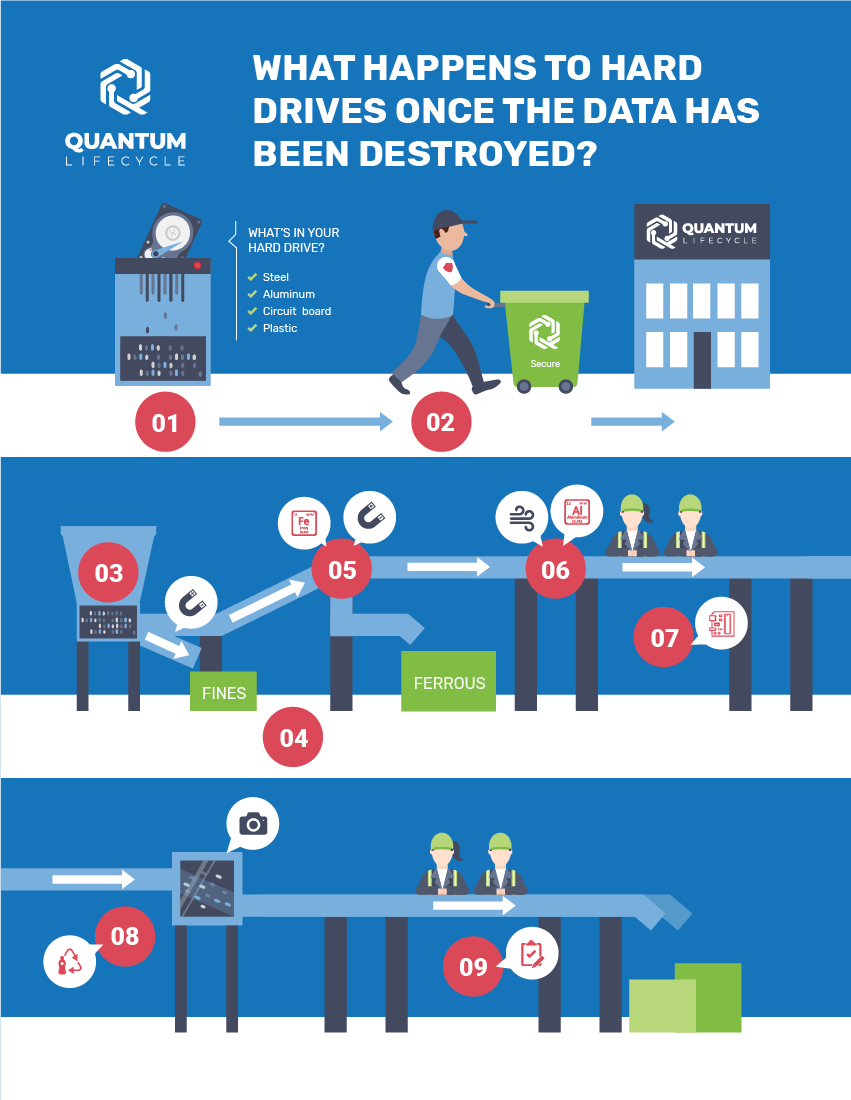
Your service provider should have multiple options for the different types of data destruction you might demand. The service you require is often driven by your own corporate policies. Be it physical destruction or data eradication, your service provider should be shredding your media to ¾” sizes and wiping data to the DoD 5220.22M standard. Quantum can assist in determining the best solution for you.
Health and Safety Systems
Work standards and laws pertaining to the safe working conditions and practices in developing countries do not exist to the same extent as they do in the West. Unfortunately, even here in North America, some firms use prison labour to handle data bearing devices. Unaudited firms often do not even really know where your material goes. ITAD service providers operating to a recognized standard have audited their downstream network to ensure worker safety (and a host of other things), protecting your company by extension.
Environmental Controls
Electronics can contain elements and substances such as mercury, beryllium, arsenic, lead, brominated flame retardants, phosphors, PCBs, and cadmium that can contaminate the soil, air and water if they are sent to a landfill or improperly managed by the person or company you are giving them to. Audited firms, like Quantum, know how their material is handled and have actively audited their downstream network to ensure the best possible environmental outcomes. They continue to audit their vendors on an ongoing basis and are subject themselves to annual audits by the various standard authorities to ensure they are meeting their obligations.
Widely Recognized Electronics Recycling and Data Security Standards
Responsible Recycling (R2)
R2, Responsible Recycling Practices, was originally created by relevant stakeholders (US EPA, state agency members, recyclers, refurbishers and their trade associations, OEMs/customers and non-governmental organizations) and is now controlled by its housing body, SERI. The R2 Certification is a way to identify and monitor best-practices in the electronic recycler and refurbishment industry. SERI’s mission is to “work to create a world where electronic products are reused and recycled in a way that promotes resource preservation; the well-being of the natural environment; and the health and safety of workers and communities.”
Firms operating to the R2 standard are audited annually by an independent 3rd party who check for the presence of and adherence to necessary policies and procedures. Auditors also verify, via mass balance, that the processor is, in fact, sending material to the approved downstream vendors.
NAID AAA
The National Association for Information Destruction program is a certification for companies that provide information destruction services. NAID certification focuses on the one thing it knows better than anyone, data destruction, and is viewed as a consumer protection watchdog association. When you are shipping to a member certified under the NAID AAA Program, this member is subjected to audits that are applicable to each location, including any mobile services that they offer. This includes the member agreeing to take place in an unannounced audit program, knowing they will be subjected to audits on any day, at any time.
Recycler Qualification Office (RQO)
The Recycler Qualification Office (RQO) operates under the Electronic Products Recycling Association, which was created by Canada’s electronics industry in order to improve the efficiency and effectiveness of Canada’s electronics stewardship programs. EPRA operates all provincial electronics recycling programs in Canada, known as Ontario Electronics Stewardship (OES) in Ontario.
The RQO administers the Electronics Recycling Standard, which is the minimum requirement for any processor operating under Canada’s provincial recycling programs. The Recycler Qualification Program (RQP) is designed to ensure that end-of-life electronics are handled in an environmentally sound and socially acceptable manner that protects data and the environment, while safeguarding worker health and safety.
e-Stewards
e-Stewards has developed its standard for Responsible Recycling and Reuse of Electronic Equipment and is consistent with data privacy requirements, environmental health and safety management system norms, international waste trade laws and social accountability standards. It was started by the Basel Action Network (BAN) and has the endorsement of major environmental groups, including Greenpeace, the Sierra Club, and the Natural Resource Defense Council. As the R2 and e-Stewards standards have evolved, recyclers are typically choosing to register with one or the other but rarely both.
Things to Consider When Engaging an ITAD Company
- Make sure they are certified to one or more standards mentioned above.
- Ask for a tour and observe the work practices and environment.
- Review their security practices and policies.
- Review the types of materials that are onsite and look for any accumulation or stockpiling.
- E-waste stored outside in an unprotected environment.
- Review their Environmental Health and Safety Policy and verify that they have taken a commitment to health and safety, environmental concerns and proper data destruction/security.
- Ask questions and speak with a company representative.
- Ask them where your material will go.
- Ensure that, if required, your vendor can generate any of the following:
- Certificate of Recycling
- Certificate of Data Destruction
- Wipe Certificate
As you’ve learned in reading this paper, the single most effective thing you can do to ensure data security and environmental performance is to engage a certified and audited firm to manage your ITAD and recycling requirements.
We are pleased to announce that effective August 1st, 2016, Revolution Recycling has purchased Twenty Twelve Electronic Recycler’s customer list and contracts. We look forward to continuing to service all of Twenty Twelve’s customers out of our Ottawa facility. This transaction follows our recent purchase of Computer Recycling Ottawa in January 2016. The pick-up operation is virtually unchanged: affordable (or even free!) pickups of old electronics and I.T. equipment from businesses in the Capital Region.
Revolution is pleased to enhance the service offering with industry leading data destruction services and IT Asset Disposition Services. We also operate an open-to-the-public drop-off depot where residents and businesses alike can discard unwanted and obsolete computers and electronics (e-waste). We are tremendously excited to continue the good work that Randy and the team at Twenty Twelve have built for the past 10+ years and wish him the best in his upcoming retirement.
Ottawa Drop Off Location
33B Capital Drive,
Nepean, ON
K2G 0E7
Ottawa Pick-Up Request Contact Information
1-888-431-0318
ottawa@revrecycling.com